User Experience Research and Design for my project
User Experience (UX) design is a concept that is not well understood by people, as the design with a focus on the visual or interface looks. Before taking part in User Experience Workshops, I had a very narrow interpretation of UX, only glancing at the surface of a digital product, as it relates to its appearance and feel. Nevertheless, it had a profoundly positive impact on my worldview as it introduced UX as a research-based and, above all, structured discipline. I found out that successful UX design starts with creating an understanding of users, their goals, behaviors, motivations, and constraints, and applies this knowledge to guide the design process.
This paper is a reflection on the way I will use the principles of user research, UX techniques, and design processes acquired during workshops in relation to my Major Project. My Major Project is a trekking information site that aims at trekking in Nepal. It is essential in aiding the decision-making, preparation, and building of confidence for the users. Since the trekking experience is not only risky, but also not well known by everyone and has complex logistics, the project needs to be approached creatively and with consideration of the user, not merely in terms of navigation and beauty.
User Research as its Fundament
Designers think that they know users, but research that is based on evidence ensures that their beliefs are not grounded in personal experience. Another significant lesson that I acquired is that untested assumptions may result in ineffective or even dangerous design choices, especially those that are high-risk. This is an important insight for my trekking site. Trekking in Nepal is associated with elevation, weather conditions, physical activities, and safety issues, particularly for foreign users and novices. Coming up with a design without the knowledge of these issues would lead to information that is too much or too little. Developing a research-oriented attitude, I would like to create an experience that would actually assist users in their information search.
My Concept
This project idea is to create a new trekking guide website that can be used by beginners, but is Nepal-based. The site will cater to first-time and novice trekkers who tend to be confused, insecure and unable to give clear information, information that is reliable and easily comprehensible to enable them to plan their trek. A lot of the available trekking sites are clumsy, over commercialized, or presuppose previous knowledge of trekking which will baffle novices.
This project suggests an easy, straightforward, and user friendly online experience which puts emphasis on simplicity, security and step-by-step instructions. The site will give truthful and open information regarding the difficulty of the treks, price variations, permits, packing needs, maps and altitude safety tips. Through the implementation of the UX research approach and the use of the iterative design cycle, the project will develop a useful and informative platform that will enable its users to feel confident, fully prepared, and supported during their trekking experience.
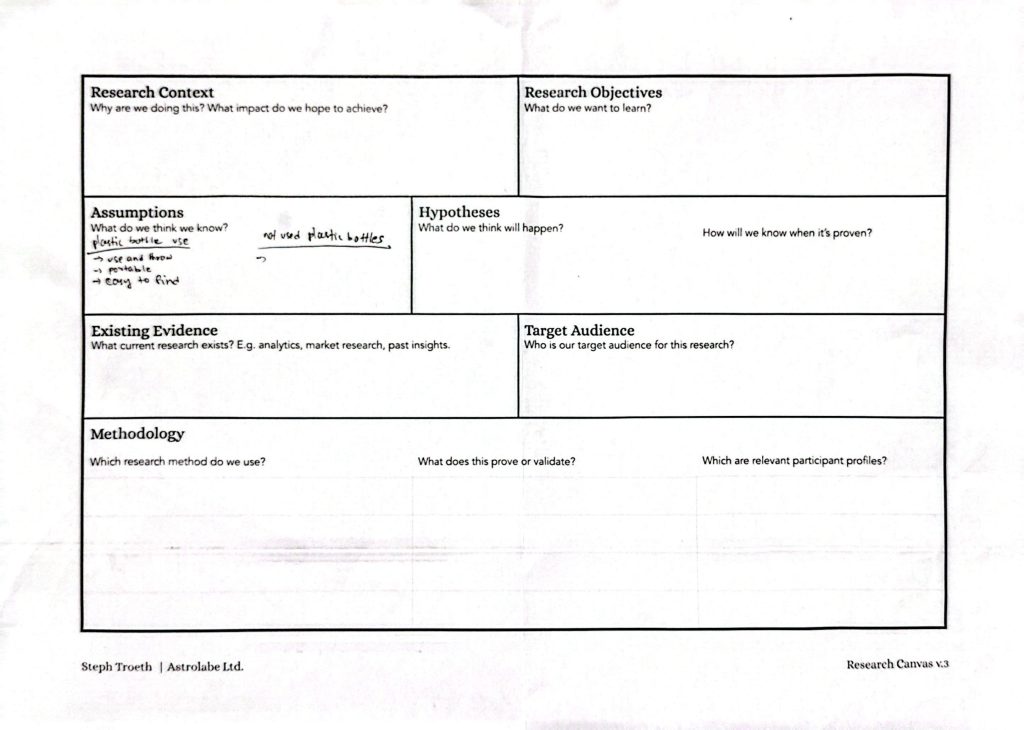
Research Canvas is a guide to organise and plan UX research. It assists in establishing what is going to be researched, the users, methods, and how the insights will be used to make design decisions. Instead of a research being done in an unstructured manner, the research canvas provides clarity, focus, and alignment during the UX process.
My choice of research canvas to inform the research planning of my Major Project, explain the assumptions, and purpose-driven and user-centred research activities will be performed through the use of the given research canvas. This strategy underlies the evidence-based design and defines a clear basis of the following phases like analysis, ideation, and prototyping.
Research Objectives
The necessity of setting specific research goals prior to the process of choosing UX techniques. Research objectives help research activities not lose their focus and relevance.
In my Major Project, the research questions of interest are:
- Knowledge on what information users require prior to selecting a trek.
- To determine issues associated with safety, weather, altitude, and difficulty.
- To investigate the way in which various users shop online in the trekking destinations.
- To discover obstacles that do not allow users to be confident or knowledgeable.
These aims inform how personas, empathy maps, and journey maps are developed and make each artefact of the UX directly related to the aims of the project.
User Research Methods
Qualitative and quantitative research, which will include:
Interviews: I will conduct interviews with novice trekkers and those people who have interests in trekking in Nepal. Such interviews will make me realize their motivation, fear, expectation, and planning problems.
Surveys/questionnaires: I will give out questionnaires to gather more general data on the level of experience with trekking, the data required, and the most frequent pain points.
Secondary research: I will go through trekking blogs, travel books, safety reports, and competitor websites to learn about the existing content frameworks and information lapses.
Competitor Analysis
I reviewed the websites on Nepal trekking, travel blogs, and tour operator sites to determine the way the users seek information before planning a trek. The majority of the competitor sites are business-oriented and focus on tour packages, prices, and call-to-action booking rather than providing clear and unbiased information. This usually complicates the efforts of the user who may just want to know about routes, preparation, culture, and risks, and make a decision.
I discovered that details about permits, acclimatization, conditions during the seasons, and the difficulty of the trails are often located on separate pages or promotional pages. Most of the sites presuppose that one already knows about trekking, and they do not take first-time trekkers through the process of planning in a straightforward or orderly manner.
Target Users using Personas
These personas affect the choices in the content depth, tone, and structure. As an illustration, the user-friendly explanations and frequently asked questions are helpful to a user such as Sarah, whereas the altitude profiles and route information are more detailed to meet the needs of a user such as Rajesh. Personas will make the site user-oriented during the design process.
Personas are a core UX method. As opposed to producing a design that is oriented towards a generic user, personas reflect a particular type of user having unique goals, behavior, and motivation. This strategy will promote empathy and deter self-referential design.



Applying Empathy Mapping
Empathy mapping is based on the personas but focuses on the way people think and feel about their experience. Workshop 1 also highlighted that knowledge of emotional and cognitive states is equally important as knowledge of functional needs.
Through mapping what users say, think, feel, and do, I will be able to determine the anxieties, motivations, and expectations. Novice hikers will be enthusiastic and nervous about their safety, whereas global users will be motivated but will have to be insecure about logistics and cultural variations. The insights have a direct effect on content presentation. As an example, the safety information will be texted in a supportive and reassuring tone as opposed to alarming. Empathy mapping assists in making the site look trustworthy, humanistic, and emotionally supportive.
Journey Map to Architecture User Flows
rney mapping is used. Journey maps are useful in assisting designers to learn the flow of users through various interaction processes.
In my trekking site, a normal trip would like to consist of:
- Exploring trekking opportunities.
- Researching specific treks.
- Knowledge of protection and precaution measures.
- Developing confidence with which to make a decision.
Mapping the journey enables me to locate the areas of pain, i.e., information overload or not knowing the level of difficulty.
Specifying Content Requirements According to the User Needs
My vision will be to build Trek Nepal as a non-commercial, user-centred informational site that is purely based on clarity, trust, and preparation.
- I will present unbiased information on well-organized trekking without sales and booking interruptions.
- I will also seek to provide the routes, the difficulty level, the height and seasonal tips in a visual and easy-to-understand format.
- I will target user education, whereby I will teach first-time trekkers what to expect upon travelling.
- I would come up with content that will be designed on the basis of user research and personas so that the information will be in line with the real user requirements.
- I will also focus on accessibility, readability, and mobile usability, which most of the competitor sites do not consider.
As a UX researcher, I will make the website helpful in making informed and confident choices that will help to position Trek Nepal as the informational resource that should be trusted and user-friendly, instead of a commercial trekking site.
Evidence-Based Design
Hypothesis-driven design was another major lesson during workshops. Instead of treI will model Trek Nepal on an evidence-based hypothesis-driven approach. In my opinion, presenting the user with clear and well-organized, neutral, and visual information about trekking will make the user feel safe and ready. Another part of my hypothesis is that the experience, fitness, and time-based persona-based trip guide would make the platform more relevant and entertaining.
This has been proved by the fact that trekkers usually have disjointed information and inconclusive planning resources that diminish confidence and add to the difficulty in planning. I will test these hypotheses by using user research, prototyping, and usability testing, which will ensure that the site is user-focused, informative, and easy to navigate.
Reframing the Problem
Problem:
I have discovered that novice trekkers usually fail to locate clear, reliable details about trekking in Nepal. The majority of the current websites are either messy, promotional, or bombarded with facts that make it hard to find crucial information, such as difficulty, prices, shipping sheets, licenses, and regulations of safety.
Solution / Value Proposition:
I will design a clean, simple, and beginner-friendly guide that is aimed at being understandable, safe, and planned step-by-step. I will be truthful and realistic in the information I will give, such as the difficulty of the trek, the prices of the trek, what type of gear to bring, the trek route, and tips on elevation. This strategy will guarantee that users to plan in a safe and secure manner without being bombarded with commercial content.
Sketching, Wireframing, Prototyping Process:
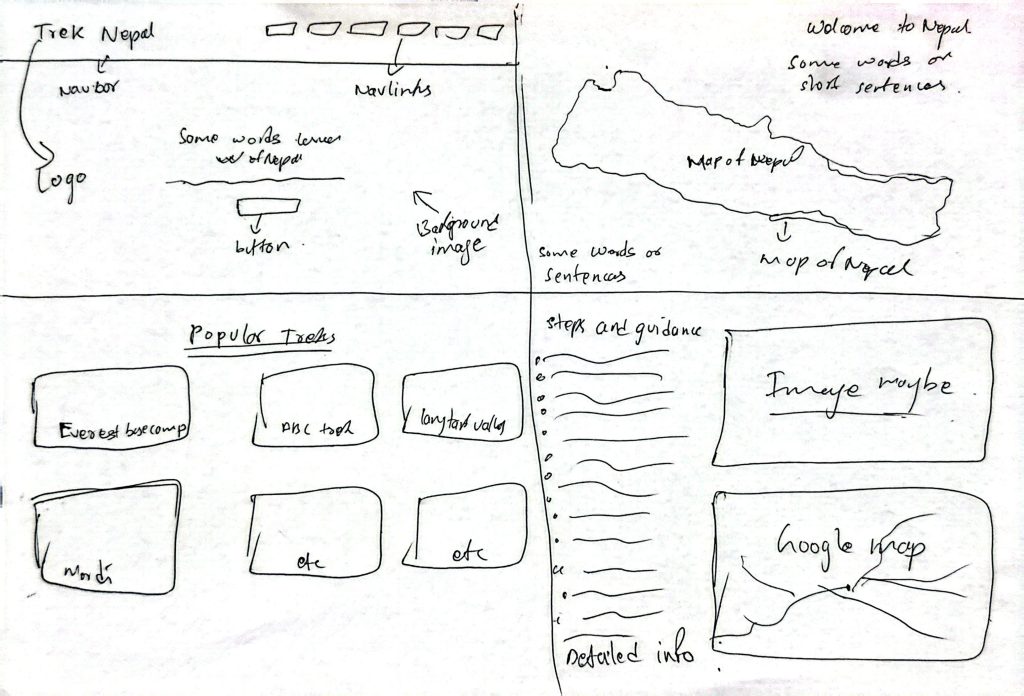
Sketching
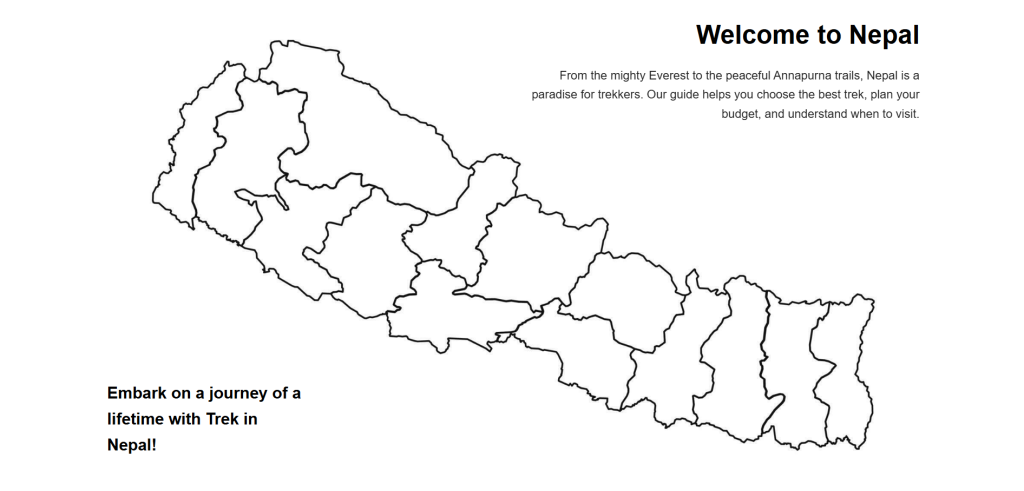
I will start off the design process by drawing preliminary ideas to be able to scout various layouts and content arrangements in a fast manner. This phase will allow me to put the research knowledge into early design ideas effectively.
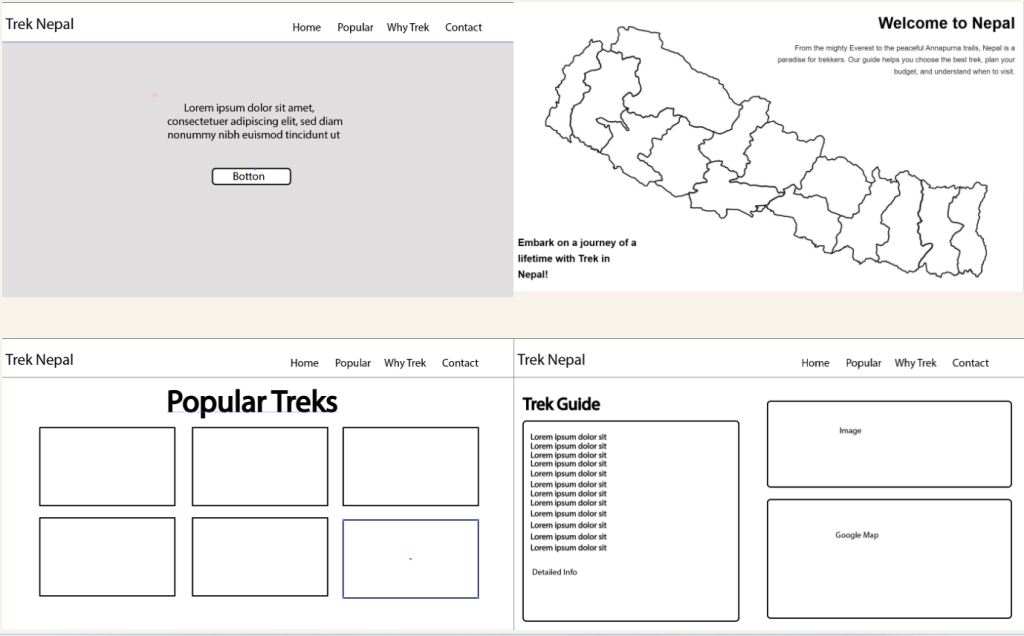
Wireframing
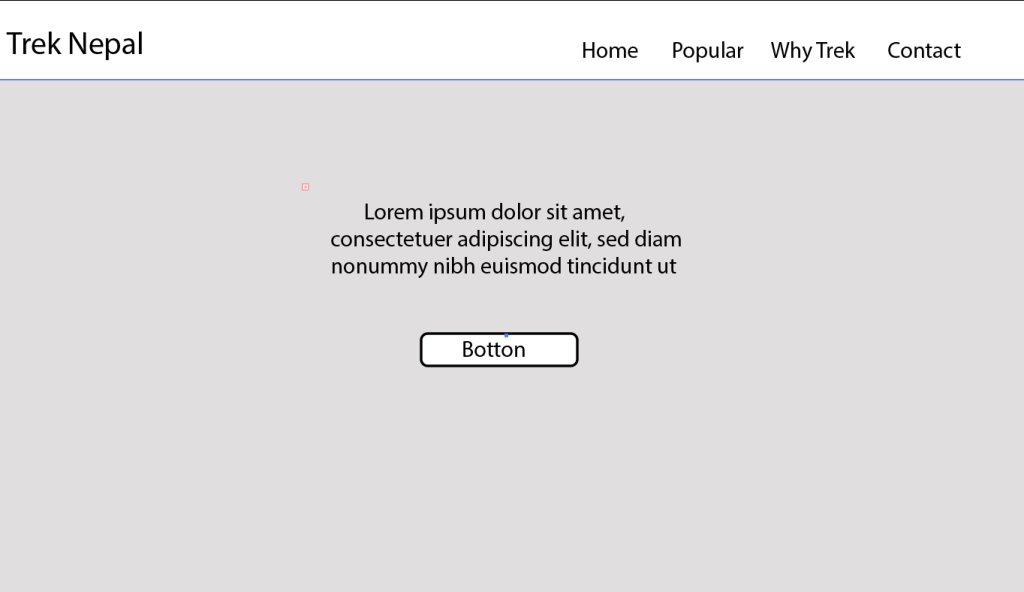
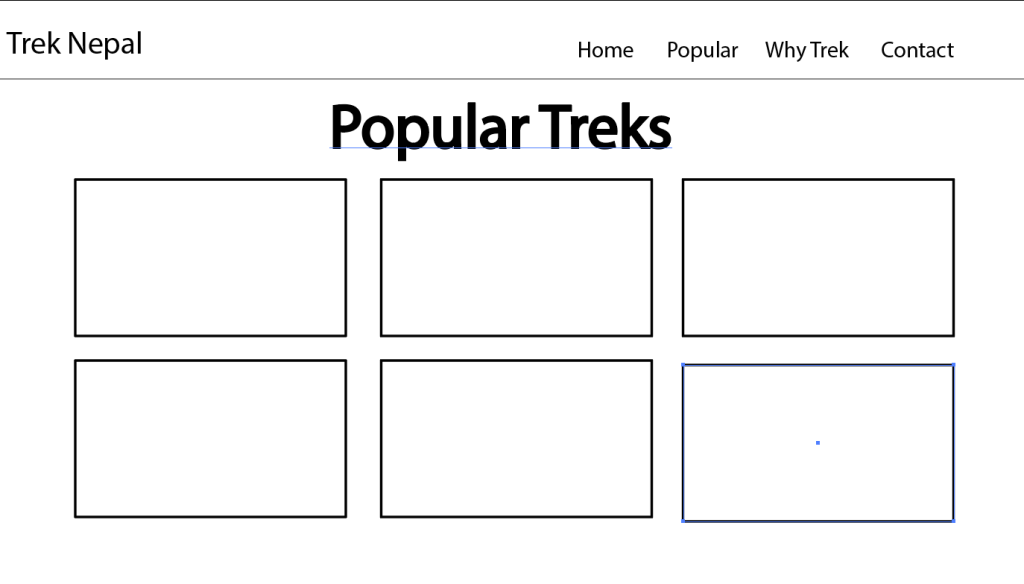
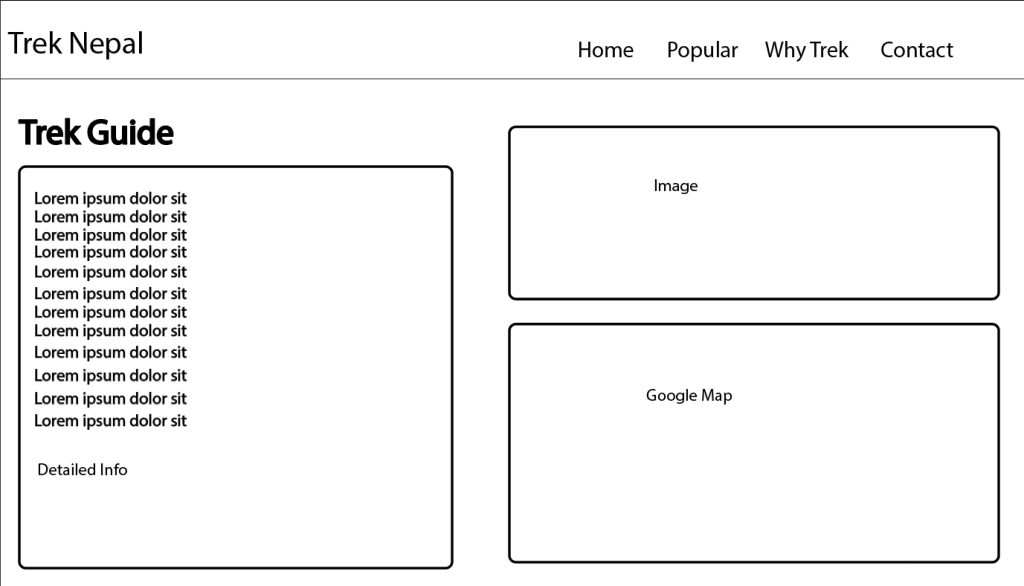
Then, I will create wireframes that will specify the layout and functionality of the site. The wireframes will be concerned with the location of the contents, user flow, and interaction patterns, and key information, like routes, difficulty levels, permits, and safety tips, will be easy to locate and comprehend. This phase aids the establishment of layout choices before proceeding to permit development on the detailed design.
Prototyping
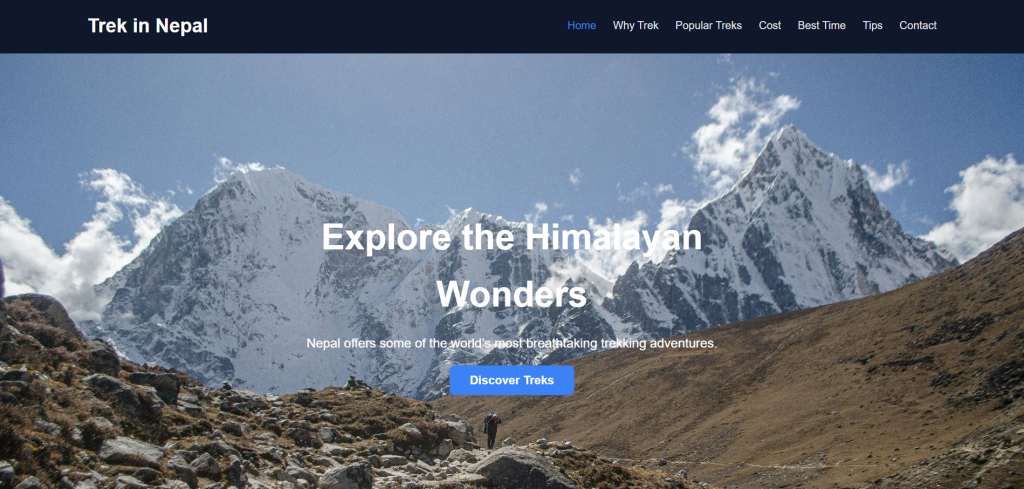
Lastly, I would develop interactive samples with the help of such tools as Figma. These prototypes will mimic actual user interactions, and through this I will be able to test the navigation, clarity of contents, and usability of the materials with the users. The design iterations will be based on the feedback of the prototyping and usability testing, and by the time Trek Nepal provides the appropriate informational experience, it has to be clear, user-centered, and effective.
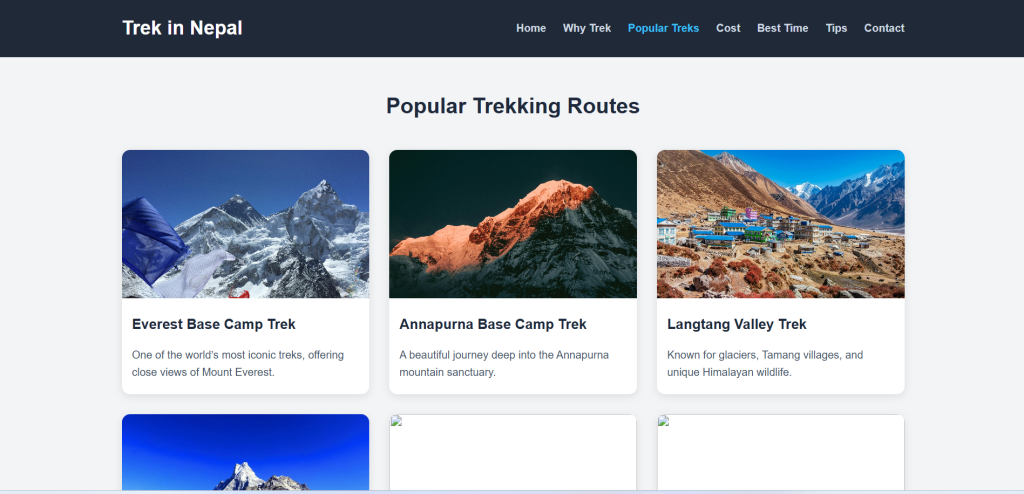
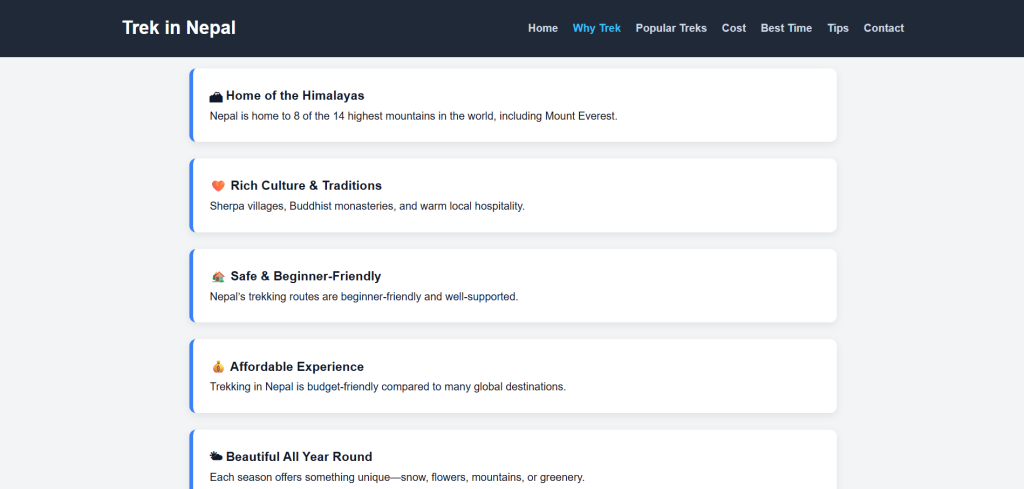
Testing: Validating Design Decisions
Testing: I will conduct a test on usability by employing representative users i.e. first time trekkers or travel bloggers to measure how easily they can find and access information. I will receive feedback regarding navigation, clarity of the content, and general user experience to repeat the design.
I will conduct:
- The task-based tests, including asking the user to locate the information about the permits or to know about the difficulty of the trek.
- Observation and short questionnaires in terms of feedback collection
According to the findings of the tests, I will:
- Enhance transparency and openness.
- It is through testing that the website works with users and not merely looking good to the eye.
Communication and Documentation
I will document the findings, insights and design choices in a formal manner, in terms of reports, annotated wireframes, and presentations. I will also make findings to colleagues or mentors, in which case, I will make my practice authentic in order to reach the transparency of design justifications.
Communication is the last step of the UX process. Without any explicit record of decisions and findings, UX design is incomplete. I will document:
- Final design decisions
- Usability testing results
- Methodology and results of research.
Conclusion
My knowledge regarding user-centered design was transformed radically through the UX workshops. Using the research-based approach of personas, empathy mapping, journey mapping, and system mapping, my Major Project will go beyond a superficial design in order to serve actual user requirements. This evidence-based, ethical, and structured approach is guaranteed to make the trekking website worth something significant as it assists the users to feel knowledgeable, assured, and ready.
References
Interaction Design Foundation – UX Design Process Guide (explains stages like research, ideation, prototyping, testing). What is the UX Design Process? 5 Steps to Success (Interaction Design Foundation)
Nielsen Norman Group – UX Research Methods Overview (lists UX research techniques and when to use them) UX Research Cheat Sheet (NN/g)
Userpilot – UX Research Process (framework for UX research phases & methods like interviews, surveys, testing) UX Research Process: A Step‑By‑Step Framework (Userpilot)
Wikipedia – Iterative Design (explains iterative approach, important in UX workflows) Iterative Design (Wikipedia)